
Hiring a marketing agency is one of the most consequential vendor decisions a residential developer makes. Get it right and you build infrastructure that produces qualified leads for years. Get it wrong and you spend a year of budget producing impressions and end up exactly where you started.
Most of the bad outcomes are predictable. The developers who avoid them ask the right questions before signing. Five questions every developer should answer (and ask the agency) before any contract is signed.
1. What is my actual goal in hiring an agency?
Be specific. “Get more leads” is not a goal. “Reach 40 reservations in the next 18 months” is. “Sell out Phase 2 by Q3” is. “Cut cost-per-qualified-lead from $X to $Y” is.
If your real need is just “post more on Instagram and run a few ads,” you don’t need a full-service agency. A freelancer or in-house person is cheaper and more accountable. If your real need is a complete system — positioning, website, content, paid, CRM, sales process — then an agency (or system-builder) makes sense.
The cost of mismatching the goal to the vendor is high in both directions. Don’t hire a strategic partner for a tactical job. Don’t hire a tactical vendor for a strategic problem.
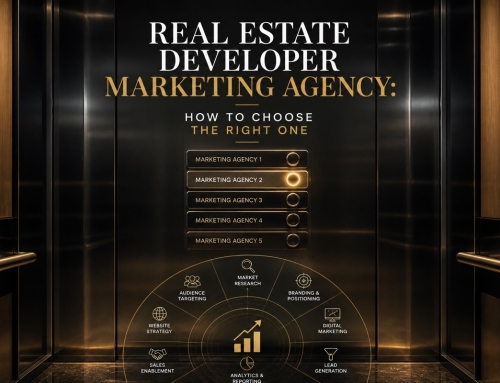
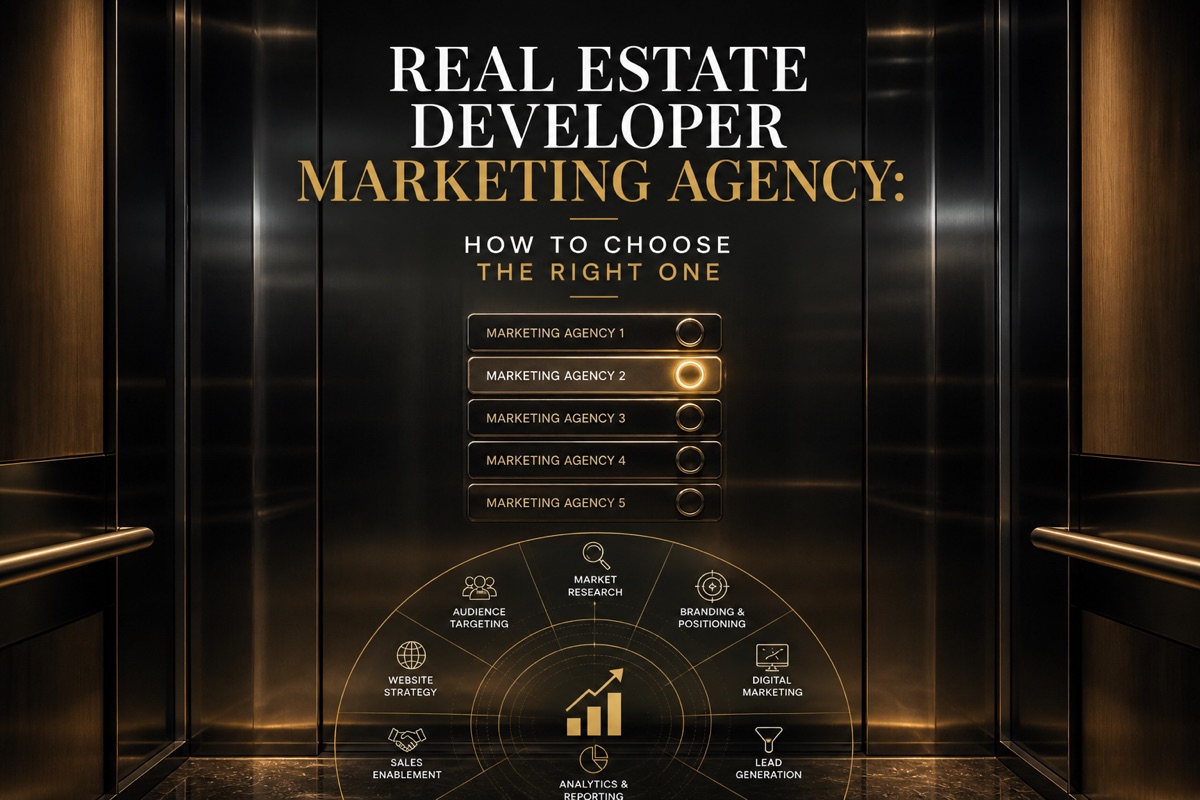
For more on the distinction between agencies and system-builders, see Real Estate Developer Marketing Agency: How to Choose the Right One.
2. How much am I willing to pay to acquire one new buyer?
If your goal involves more closed units, work the math backward. What’s a closed unit worth to you in margin? What percentage of qualified leads convert to reservations and then to signed contracts? What’s the maximum you can spend per qualified lead and still be profitable?
That number anchors every conversation with the agency. Ask them what cost-per-qualified-lead they expect for your specific market and product, based on their experience. If the number doesn’t make sense for your unit economics, the engagement won’t either.
Paid channels operate as auctions. Costs go up when more developers compete in the same county for the same buyer. The agency that can give you a credible number — and explain the assumptions behind it — is the one worth hiring.
3. What do I want to build for the long term?
Paid advertising produces leads while the campaigns run. The moment you stop, the leads stop. That’s fine as part of a balanced system — but if it’s the only thing the agency does, you have nothing left when the engagement ends.
What you want for the long term:
- Search authority — both Google rankings and AI search citations (ChatGPT, Perplexity, Gemini).
- A content library that keeps producing organic leads for years.
- An owned email list and CRM history of every buyer interaction.
- Owner relationships that produce referrals at lower acquisition cost than any ad channel.
Ask: “If our engagement ends in 12 months, what owned assets do we walk away with?” The answer tells you whether the agency is building for your interests or theirs.
4. What digital tools do I already have, and which ones do I need?
Audit what you have now. A website that captures leads (or just shows pretty photos)? A CRM (or a spreadsheet)? Email lists (or scattered owner contacts in different agents’ phones)? AI search visibility (or zero presence in ChatGPT answers about your county)?
Most developers have 30–50% of the infrastructure they need and don’t realize the rest is missing. The agency you hire should be able to map what’s missing and what to build first. The order matters: a CRM with no leads to capture is wasted; lead generation without a CRM to nurture is leaky.
For most developers, the minimum stack in 2026:
- Website built for lead capture (not just gallery).
- CRM (HubSpot or comparable) configured for the residential buyer journey.
- Email and WhatsApp nurture infrastructure.
- Paid ad accounts (Google + Meta) under your ownership.
- Content production system that earns Google + AI search authority.
- Attribution dashboard that connects ad spend to closed units.
5. How does this fit into my broader strategic plan?
The agency engagement should fit your business plan, not the other way around. How many closed units do you need this year? Next year? What’s your budget reality? What’s the ramp time before paid channels produce returns? What’s the realistic SEO + AI-search timeline for your category?
Ask the agency to project — based on their experience with comparable projects — what results to expect at 90, 180, and 365 days. Compare that to your own plan. If the math doesn’t work, don’t sign. If it does, you have a real foundation for the relationship.
The bonus question
“What does your build process look like in the first 90 days, and what specifically gets delivered?” Vague answers here predict vague results later. A serious partner can describe weeks 1–4, 5–8, and 9–12 in concrete terms.
This is exactly how we build the Real Estate Growth System — an 8-to-10-week implementation, with full ownership transfer at completion. No agency lock-in. No mystery about what gets built.