
Johnny Murphy called me one day in 2010 and said: we need to create a website that has a business directory, interactive maps, videos about the community, and everything a person would need to know if they were thinking about moving to Richmond Hill, GA.
Johnny was one of the biggest land developers in the Southeast. He understood real estate the way very few people do — not just the transactions, but the communities, the emotions, the need to communicate everything just right. The texture of a place, the feeling, or what he called The Reflections — what makes people choose a town and commit to it.
And in 2010 — before social media had become the organizing force it is today, before content marketing was a recognized discipline, before anyone in residential real estate was talking seriously about inbound lead generation — Johnny already knew that the way to capture a buyer wasn’t to advertise a home. It was to become the most useful, comprehensive resource for someone deciding whether to build their life in your community.
That call was the beginning of the company “Towns Live.”
Building something nobody had a name for yet
We called the company Towns Live, Inc. The idea was to put smaller towns online — “alive” or “LIVE” — current, useful. Not a static listing. An actual resource.
In the mornings, I’d walk into small businesses in Richmond Hill and try to convince them to be part of our online directory, just with an iPad and a mock-up: restaurants, contractors, services, local institutions, everything that made the town a real place to live rather than just a location on a map. In the afternoons and into the nights, I was coding — building the architecture of the site. Interactive maps. Video content about the community. The kind of comprehensive local resource Johnny had envisioned.
It took four years. We sold the company in 2014.
Looking back through the lens of what I know now, Towns Live was an early version of something the real estate industry is still struggling to execute correctly: a lead generation system built around the buyer’s research journey rather than the developer’s desire to advertise.
Johnny understood something fundamental. A person doesn’t choose a home in isolation. They choose a community — the schools, the restaurants, the neighbors, the feel of the streets, the proximity to the things that matter to their family. If you could become the place they go to research all of that, you weren’t just marketing to buyers. You were becoming the trusted authority who helped them make one of the most important decisions of their lives.
That is still, twenty-plus years after that phone call, the right model for residential developer lead generation. Most developers still haven’t built it.
Why most residential developer lead generation doesn’t work
Walk into a conversation with most residential developers about their marketing and you’ll hear the same things: we run Google Ads, we post on social media, we have a website with our floor plans and pricing.
And when you ask whether those activities are producing qualified buyers consistently, the answer is usually more complicated. The leads come in waves, tied to ad spend. The sales team doesn’t know where most leads are coming from. The website looks good but doesn’t convert at the rate it should. The social media posts get likes from people who will never buy a home in this market.
The problem isn’t the channels. It’s the model.
Most developer marketing is built around the product: the homes, the community features, the pricing. Here’s what we’re building. Here’s what it looks like. Here’s how to contact us.
That model works when buyers are already decided on your community and just need to find your contact information. It does nothing for the buyer who is six weeks into comparing three different communities and hasn’t committed to anything yet.
That buyer — in the middle of a 90-to-180-day evaluation process — is where the lead generation opportunity is. And capturing that buyer requires what Johnny Murphy understood in 2010: you have to be useful to them before they’re ready to buy.
What residential developer lead generation actually looks like
The lead generation system that works today follows the same underlying logic as Towns Live — serve the buyer’s research journey, not just the developer’s sales message — but organized through a framework that connects every piece.
At Enroke, we call this the MERCA system: Map, Emotion, Route, Conversion, and Amplification. Johnny’s vision was, in many ways, an early version of all five blocks working together. He was mapping a specific community identity (Richmond Hill), creating an emotional attachment to a place (the Emotion block), building the route that brought in-market buyers to find it (Route), and doing it in a way that would generate trust long before any sales conversation happened (Conversion). The amplification — every local business, every community resource on the directory, making the whole thing more valuable over time — was baked into the model from day one.
Today, with the digital infrastructure 2026 makes available, those five blocks look like this (integrated as a system).
1. Community-first content that earns the research phase (Map + Emotion)
Before any buyer submits a form or calls your sales office, they’ve spent hours online — and increasingly, asking AI assistants. They’ve searched for information about your community, your town, your schools, your commute corridors, your HOA, your builder reputation.
If the only content they find from you is product-focused — floor plans, pricing, feature lists — you’re almost invisible during the most important part of their decision process.
The developers who win the research phase think about their audience first. What’s the buyer persona we are trying to serve? Then they publish content that serves the buyer’s actual questions: What’s it like to live in this community? What are the best schools in the area? What does the commute look like? What happens after the homes are built?
This content doesn’t just build trust. It builds search rankings — and, increasingly, citations inside AI answers. A buyer who finds your community through an article about the Richmond Hill school district, or a guide to coastal Georgia living, is warm before they ever see a floor plan. A buyer whose ChatGPT search surfaces your community as a credible answer is even warmer.
2. Paid advertising built for intent, not awareness (Route)
There is a moment in a buyer’s research process when they shift from passive exploration to active evaluation. They start searching with specificity: “new home communities in [county],” “master-planned communities near [city],” “new construction [price range] [market].”
That is a high-intent signal. A buyer who types that search is telling you exactly where they are in the decision process.
Google Ads targeting those specific queries — written with copy that speaks to the buyer at that moment of active evaluation — produces a categorically different lead than an awareness-focused ad running to a broad geographic audience. AI search visibility (whether ChatGPT names your community as a credible answer when a buyer asks about new builds in your county) increasingly belongs in this same block. Both are intent-driven Route work.
3. A CRM/software that connects the research phase to the sales team (Conversion)
This is the component that makes everything else work — and the one most developers either skip or underinvest in.
Without a configured CRM, every lead enters the same bucket. A buyer who found your community through a school district article and has been researching for six weeks gets the same follow-up as someone who clicked an ad and will never respond. The sales team follows up on whoever seems most promising. The rest get forgotten.
With a CRM built for the residential developer buyer journey — lead scoring based on engagement behavior, automated nurture sequences that respond to what a buyer has actually looked at, AI sales assistants that respond in 60 seconds, and pipeline stages that reflect how decisions really get made — your sales team has context before they make contact. They know which buyers are close. They know what questions those buyers have been researching. They have something real to say.
That context changes the sales conversation. It reduces the number of contacts needed to move a buyer to a tour. It gives the sales team the ability to prioritize their time on the leads most likely to close.
4. Nurture and amplification that compounds over time (Amplification)
A buyer who submits a form in week three of a 90-day research process is not ready to buy. They’re ready to learn. If your follow-up sequence is designed only to convert immediately — aggressive calls, urgent pricing emails — you will lose them.
The right nurture sequence moves with the buyer. Early-stage content serves their research. Mid-stage content differentiates your community. Late-stage content handles objections and creates urgency for buyers who are close.
This sequence runs automatically. It doesn’t require a salesperson to remember to send the right email at the right moment.
And it doesn’t stop at the close. Every homeowner who has a great experience is a referral engine, a testimonial source, and a trust signal for every future buyer who researches your community. At Heartwood, 94,000+ organic Google Search impressions and 135,000+ social media views over the first seven months were produced not just by paid investment, but by a content ecosystem that resident engagement helped sustain.
The vision still holds
When Johnny Murphy called me in 2010, he wasn’t thinking about CRM platforms or automated sequences. He was thinking about something simpler and more durable: if you become the most useful resource for someone making one of the biggest decisions of their life, they’ll trust you before they ever meet you.
Looking back through the lens of what I know now, I know Johnny was ahead of his time, and his passing was too soon and too unexpected. But if he could see what we are building and how it is more relevant now than before, he’d be proud. His vision is still the right model.
The technology has changed, which makes things easier for us in that sense. The tools available — paid search with conversion tracking, content that ranks in Google and gets cited in AI answers, HubSpot workflows, AI that responds to every lead in 60 seconds — are incomparably more powerful than what we had building Towns Live. But the underlying principle is the same.
Be there. Be useful. Be present across the entire journey. Build trust before you ask for anything.
Developers who figure that out don’t just generate more leads. They generate better ones. Buyers who arrive already trusting you are easier to convert, less price-sensitive, and more likely to refer the people they know.
What the implementation looks like
The Real Estate Growth System is not a monthly service. It’s a build.
We construct the complete infrastructure — from strategic positioning through community content, paid campaigns, HubSpot or your CRM, AI sales assistant, automated nurture sequences, and attribution dashboard, and more — in 8 to 10 weeks. The implementation runs approximately $10,000. When we’re done, every account, every automation, every sequence, and every asset belongs to you. No agency lock-in.
Most clients choose optional monthly maintenance at $500 to $1,000/month afterward, because systems need ongoing attention as market conditions shift and campaigns mature. But that’s your decision.
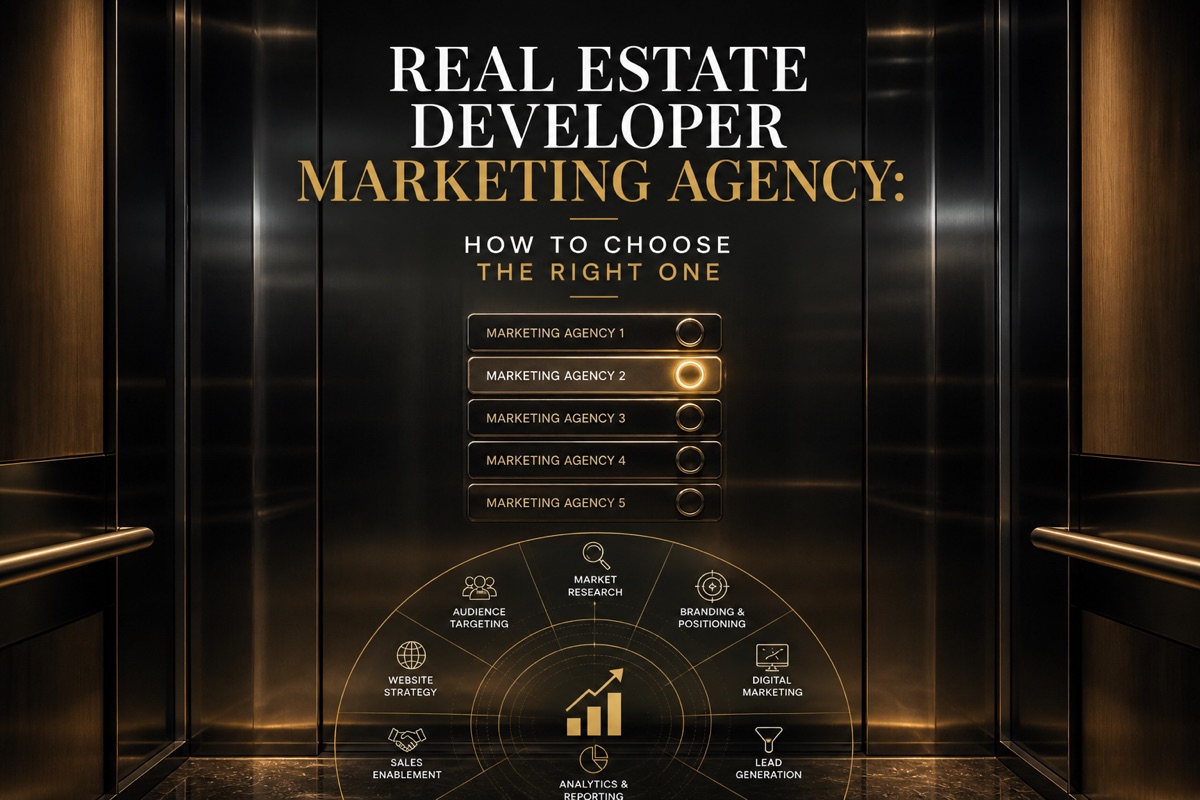
The business case is the same one Johnny Murphy was making in 2010, just with better numbers: if the system makes you the most useful resource for buyers researching your community, you stop paying to rent someone else’s audience and start owning the relationship from the first search to the signed contract. For more on what to look for in a partner to actually build this with you, see Real Estate Developer Marketing Agency: How to Choose the Right One.
FAQ: residential developer lead generation
What is the best lead generation strategy for residential developers?
The most effective strategy combines community-first content that serves buyers in the research phase, high-intent paid advertising on Google and Meta, AI search visibility, a CRM with automated nurture sequences, and retargeting campaigns that keep your community visible throughout the buyer evaluation window. Each component serves a different stage of the buyer journey. The most common failure is investing in paid advertising without the CRM and nurture infrastructure to convert what it generates.
How do residential developers generate leads without relying on agents?
A direct-to-buyer digital system — website optimized for lead capture, search ads targeting active buyers, content that earns organic search rankings and AI citations, and CRM-based nurture — generates buyer leads independent of agent relationships. Agents remain a valuable channel. The goal is a parallel owned system that reduces single-channel dependence, not the elimination of the agent network.
How long does lead generation take to produce results for a residential developer?
Paid advertising produces leads within two to four weeks of a well-configured campaign. Content marketing and SEO typically produce meaningful organic traffic within three to six months. A full system usually shows clear ROI within 90 days, with performance improving over time as the CRM accumulates buyer data and content builds search authority.
What does it cost to build a lead generation system for a residential developer?
A complete Real Estate Growth System implementation — covering all five MERCA blocks from strategic positioning through homeowner amplification — runs approximately $10,000. Optional monthly maintenance is $500 to $1,000/month. The return comparison: one additional closed home at typical builder margins pays for the entire implementation many times over.
What makes residential developer lead generation different from other real estate marketing?
Residential developers are marketing communities, not just homes. The buyer’s research process is longer, more intensive, and more emotionally complex than a typical consumer purchase. The marketing system has to serve that process — building trust and providing useful information across a 90-to-180-day window — not just generate immediate responses. Generic agency frameworks weren’t built for this. The MERCA system was.
Next step
The first step Johnny Murphy always took before committing to anything was to understand the full picture first. That instinct is still right.
Start with the free AI Marketing Audit: 10 questions about your current marketing situation. The system analyzes your inputs and delivers a one-page custom report in under 30 minutes — your biggest lead generation gaps mapped against the MERCA framework, the specific modules that address them, and realistic projections for 90 days. No sales call. No commitment.