
How do you get your project in front of buyers?
The default answer today seems to be: social media advertising or digital marketing. It is the simplest answer. It is fast. It is fun. The cost looks accessible. And for some products, it is partially effective.
That said — if you have run paid social for a development project and the results were not what you hoped for, you already know paid advertising has problems. This is the trap, and the five reasons it is a trap.
When advertising stopped working
A couple of decades ago, advertising had a small set of channels. Mass media controlled the content most of us consumed. Suppliers of products and services were limited too. Direct producer-to-consumer sales were rare.
Back then, one of the most efficient ways for a company to grow brand awareness — and possibly sales — was mass-media advertising, earned media coverage, and product placement in the right distribution channels. Ads were a way to buy recognition, to buy a slice of fame.
That is why people confused marketing with advertising; and even today, they confuse digital advertising with digital marketing. But the internet went mainstream and advertising stopped working the way it used to.
More communication channels and more distribution channels
Websites filled up with information about anything you could want to buy. Digital platforms broke the monopoly on communication channels. Apps made it easier to access products and services. Google, YouTube, and now AI assistants like ChatGPT put an answer to almost any question in arm’s reach. Smartphones let us do all of it from anywhere, at any time.
More communication channels and more distribution channels than ever before. And with that, advertising changed.
Digital advertising on its own is not profitable for most developers
In the middle of the digital transformation, builders and developers ask for digital marketing. What they get is digital advertising, with no full strategy, no lasting profitability, and a list of problems.
1. Ads are so easy to run that everyone is (or thinks they are) an expert
How easy is it to be an expert in everything, that quickly? There are more variables in play than ever:
- The Meta Ads expert promises you the right audience.
- The LinkedIn expert promises you the decision-makers.
- The X (Twitter) expert promises you the opinion leaders.
- The SEO expert promises you the top spots in search results.
- The AI search expert promises you visibility in ChatGPT, Gemini, and Perplexity answers.
- The web design expert promises you the most attractive site.
- The CRM expert promises you the cleanest pipeline.
- The communications expert promises you the best content.
With that many “experts” and relatively low prices, it is not just confusing to know what is actually working — most companies end up doing whatever the latest expert told them to do. When everyone does the same thing, you hit the next problem.
2. Digital advertising works as an auction
Five years ago, an organic Facebook post from a page with 1,000 followers reached around 400 people. Today the average organic reach is closer to 20 to 40 people. To reach more, you have to pay.
Paid Facebook ad costs are 10 to 100 times higher than they were a few years ago, depending on your country and industry. There were fewer advertisers and fewer eyeballs back then. Today there is more of everything.
The same is true on every platform — and even with your own website. Fifteen years ago, you barely had to do anything to get traffic. Today it is almost impossible to launch a new website and rank for anything without a deliberate effort. If you want results in the short term, you pay. The cost is set by an algorithmic auction based on the queries you want to appear for.
Very few products or services can still make digital advertising on its own profitable. Real estate is rarely one of them. The 90-to-180-day buyer journey on a multi-hundred-thousand-dollar purchase needs more than an ad — it needs a system.
3. Digital advertising is the cheapest advertising and the most ignored
A common estimate is that 99% of advertising is ignored by 99% of users. Imagine the waste.
Even when you put the price right on a social ad, the most common comment is still: what’s the price?
Here is a real number from a campaign we ran. In our last paid Facebook + Instagram campaign at Grupo Enroke, we got 20 interested replies for every 10,000 people who saw the ad. That is a 0.2% response rate. In other words, 98.8% of the people who saw the ad ignored it. With tight targeting. With an attractive offer. From a team that has been doing this for more than a decade.
Just ask yourself: how many times a day do you go on social media to buy something?
Not many.
4. Social networks are not really social anymore — they are interest media
This one has shifted significantly since the original version of this post. The framing used to be: “social networks are still social, you go there to connect with friends, and ads disrupt that.” That was true in 2019. It is no longer the dominant truth in 2026.
The feed on Instagram, TikTok, X, and YouTube is now algorithmically curated by interest, not by who you follow. Most of what you see is from accounts you do not follow. We don’t go to social media to keep up with friends as much as we did. We go to consume content on whatever the algorithm has decided we are interested in this week.
That changes the implication, but not the conclusion. Social media is interest media — and your buyers are on interest media to be entertained or informed about a topic, not to buy a unit in a project they have never heard of. The ad alone does not move them. What moves them is content that genuinely earns their attention inside the topic they are already curious about, and a system that picks them up the moment that curiosity becomes intent.
5. The buyer journey now includes AI search, and most ads ignore it
Five years ago, a buyer’s research started on Google. Today it often starts in ChatGPT, Perplexity, Gemini, or Google’s AI Overviews — and ends with a comparison across all of them.
Ask a buyer about a coastal Georgia community and watch what they do: they don’t type a query into Google. They ask an AI assistant which builders are reputable, which neighborhoods appreciate, which schools are best, which developers actually deliver on time. The AI answers based on whatever it has indexed and synthesized about you across the web.
Most digital advertising is disconnected from that journey. Ads focus on the project being pushed, not on the content footprint that earns trust during the research phase that now includes AI as the first stop.
If you are not visible in AI answers about your category, the ad budget is paying for the second-best impression in the buyer’s journey, not the first.
The trap: digital advertising distracts you from real digital marketing
Marketing exists to drive exchange and generate sales. That comes from understanding your buyer, their journey, their worldview, their needs, their fears, their problems and desires.
Marketing has to communicate, in a coordinated way, why a buyer should choose you and not the alternative — not just your prices, but your differentiation. Your digital marketing should focus on delivering more value to the people who already trust you, on building real relationships, on getting buyers to refer you, on making sure that owning a unit in your project says something about the kind of person they are.
That kind of marketing — better marketing — needs more than digital tools. It needs value: digital content centered on your buyer. It needs automation, but only of processes worth automating. It needs an integrated strategy with a real mission and vision. Above all, it needs to start from the conviction that marketing is more than advertising.
This is the entire point of the MERCA framework — Map, Emotion, Route, Conversion, Amplification — and the Real Estate Growth System built around it. The Route block (paid + organic + AI search visibility) is one of five blocks. Most ad-only operators only run that one, and only halfway.
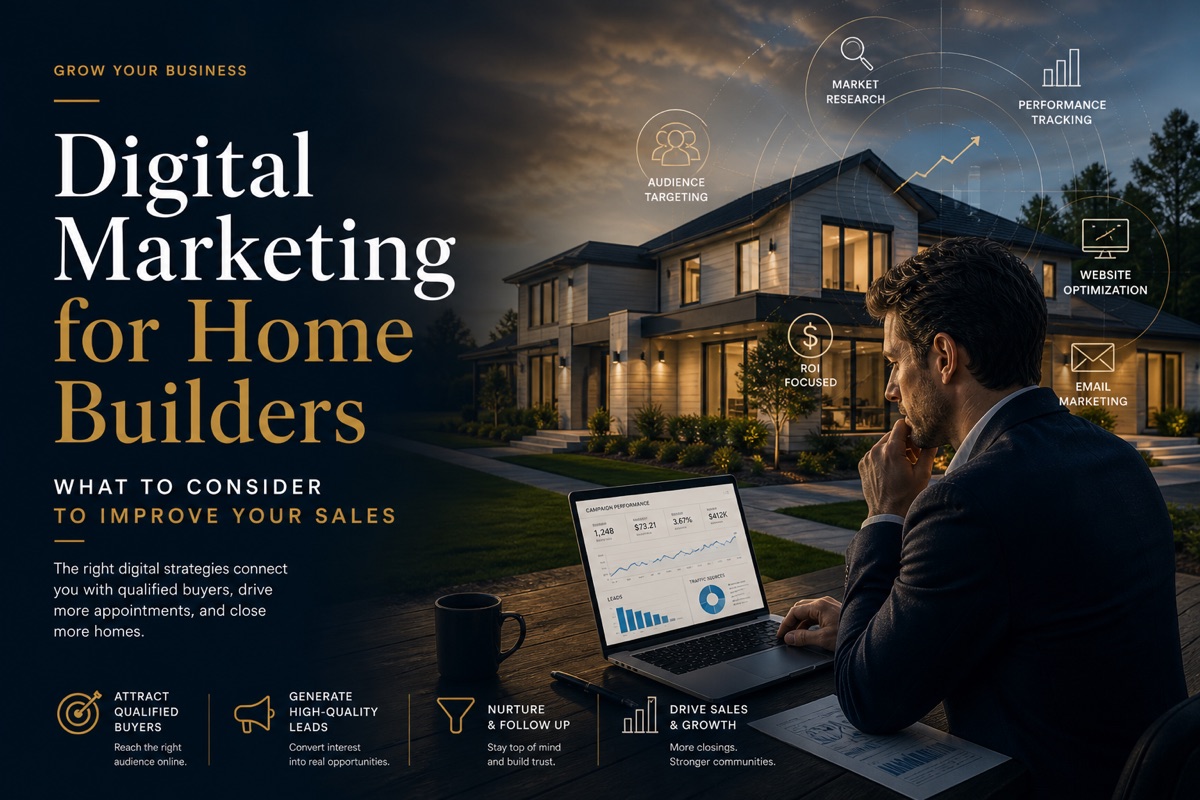
For more on what a complete system looks like for a residential developer, see Digital Marketing for Home Builders: What Actually Works in 2026.
Are you ready to walk away from the ad-only trap and run real marketing for your projects?
Conclusions
- Traditional advertising stopped working the way it used to.
- The new advertising — digital advertising — is not profitable for most developers on its own.
- Confusing digital advertising with digital marketing is a costly mistake that pulls you away from what actually drives sales.
- Be cautious of the “expert of the experts” of the moment. There are too many variables for many people to legitimately be experts.
- Remember that digital advertising works as an auction. Costs go up as more developers pile in. Plan for integrated marketing strategies instead.
- Digital ads are the most ignored medium. Build long-term strategies.
- Social networks are no longer social — they are interest media. Build for the buyer’s curiosity, not the buyer’s friend graph.
- The buyer journey now includes AI search. If you are invisible in AI answers, your ads are paying for second place.
- Don’t let advertising distract you from real marketing. The system matters more than the channel.