When I was CFO at Coastal Living Homes in Richmond Hill, Georgia, I watched our sales team spend most of their time chasing leads that came from two places: agent relationships and Realtor.com. Zillow had just been founded in 2006 and we used it mainly for Estimates. We had no CRM, no automatic pipeline or attribution, and really no idea which marketing dollar was producing which buyer.
We spent a LOT of money on an ERP (Sage) and were concerned more about the building process than the sales process. The leads usually just came in, deals got closed, and nobody asked too many questions.
Then the national builder moved into the market. Not only were they better-funded, with a real marketing infrastructure behind them, but the market was at its peak. It was 2007. Suddenly the agent relationships weren’t producing the same results. The website leads got more expensive. The sales cycle got longer because buyers were now comparison shopping online before walking into anyone’s sales office.
Our sales started to slow down, and I knew I needed to pivot my role from just a CFO, to someone who could help with sales. That need is what turned me into a digital marketing operator for real estate. It wasn’t an easy transition. It was a forced one. I was not a consultant who studied the industry from the outside. I was an operator, who watched it change from inside and had a REAL need to sell.
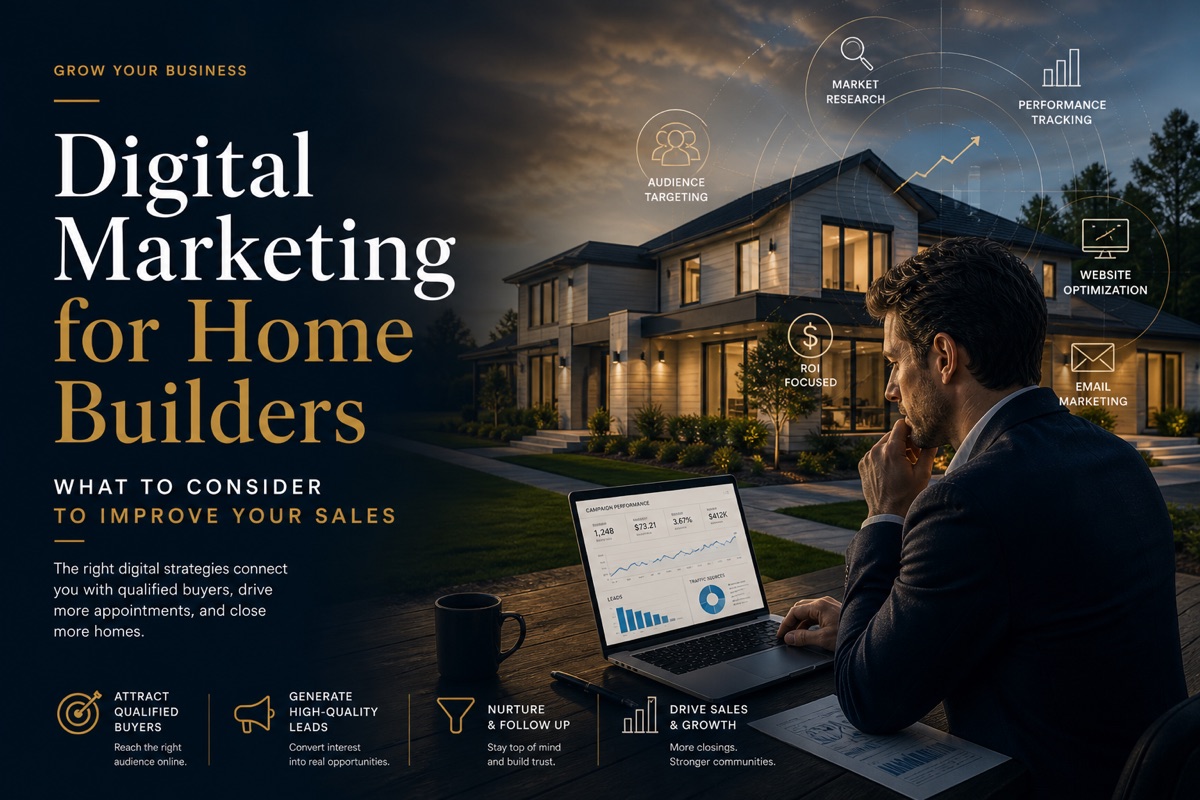
What I’m going to walk through in this article is what digital marketing for home builders actually looks like when it’s built to work as a sales machine.
Why home builder marketing is different
Before getting into the components of an effective digital marketing system, it’s worth being clear about why home builder marketing is different from virtually every other industry.
The sale takes 90 to 180 days from first contact to contract. Buyers research extensively before reaching out to anyone. They compare communities across multiple builders, sometimes driving the roads on weekends before submitting a single form. The decision is one of the largest financial commitments of their lives, and the emotional stakes are even higher than the financial ones.
This means that a generic digital marketing approach — run some ads, post on social media, optimize the website — misses the point entirely. You’re not selling a product people can return if they change their mind. You’re selling a community, a lifestyle, and a promise that your company will deliver on a multi-year building process.
The marketing system has to match that reality. It has to capture awareness from buyers who aren’t ready yet, nurture them through a long research phase, and give your sales team qualified, warm leads — not form fills from people who wanted your floor plan PDF and will never answer a call. And it has to prove ROI at every stage, so you know which channels deserve more budget and which ones are burning money.
The five components that actually move the needle
After building marketing systems for multiple residential communities over the years, including five-plus years running digital growth for Heartwood at Richmond Hill — a 20,000-acre master-planned community backed by Raydient Places + Properties (Rayonier NYSE: RYN) — I’ve identified five components that consistently determine whether a home builder’s digital marketing drives sales or just drives activity.
These five components aren’t isolated tactics. They’re connected blocks: each one feeding the next. At Enroke, we organize them under the MERCA framework: Map, Emotion, Route, Conversion, and Amplification. Every system we build follows that sequence, because the sequence is what makes individual tactics compound into a machine.
1. Strategic positioning before anything else (Map)
Most builders go straight to ads. The first question should be: what position do you own in your buyer’s mind, and is every piece of your marketing reinforcing that position?
A website built around beautiful photography is not a position. A community with a specific lifestyle identity, targeting a specific buyer profile, with messaging that speaks to what that buyer is carrying emotionally — that’s a position. Everything downstream of this decision becomes easier or harder depending on whether you’ve made it consciously.
2. A website built for buyer research, not builder pride (Emotion)
Most builder websites are portfolio pieces. Beautiful photography, community maps, floor plan galleries. But they’re not built to convert. There’s no clear path for a buyer to identify themselves, enter the funnel, and receive relevant follow-up.
At Heartwood, one of the highest-performing pages on the site wasn’t the gallery or the feature list. It was an interactive community map — a tool that let buyers explore the land, the lots, and the surrounding area. Buyers spent time there. They came back. They gave their email to get updates on lot availability. The website was doing the emotional work of the first sales conversation before any human-to-human contact happened.
3. Search advertising that targets intent, not awareness (Route)
When a buyer types “new homes near [city]” or “master-planned community [county],” they are not browsing. They are actively evaluating their options. That is the moment to be visible.
Working with different developers and builders, we have achieved on average a 12.42% click-through rate on Google Ads in a market where the industry average sits around 2%. That performance comes from writing ad copy that speaks to what the buyer is thinking at that exact moment (and of course, a well-branded product). We have done that consistently while generating 1.5 to 2.5 times more qualified leads on a total ad spend of $10/day. That’s the power of targeting intent.
Worth flagging here: in 2026, “search” is no longer just Google. Buyers ask ChatGPT, Perplexity, and Gemini for honest takes on builders, neighborhoods, and schools. The Route block now has to plan for AI search visibility too, not just paid search and SEO.
4. A system/CRM that connects marketing to sales (Conversion)
This is the component most marketing agencies for builders skip, and it’s the one that makes every other component work. Without a CRM, your marketing generates leads that enter a black hole. The sales team follows up on the ones that seem promising. The rest get forgotten. You have no idea which ad produced which buyer or which nurture email moved someone from “browsing” to “scheduled a tour.”
With HubSpot configured correctly for a homebuilder’s buyer journey — or a proprietary software depending on the builder’s need — you get lead scoring, automation triggers, and pipeline stages that reflect how buyers actually make decisions. Marketing agencies and builders tend to focus on one of two things: they either want/offer the technology, or want/offer the nice ads. But if you can use both, AND talk to your buyer persona, this is what gives you the attribution data to make intelligent decisions about budget, messaging, and sales team priorities.
5. Homeowner amplification that reduces acquisition cost over time (Amplification)
Most digital marketing systems stop at the closing. The best ones don’t.
Every homeowner who has a great experience is a referral engine, a testimonial source, and a trust signal for every future buyer who researches your community. A system designed to capture and activate that satisfaction — structured referral programs, resident-generated content, NPS tracking — makes every subsequent sale cheaper to acquire than the last.
For a deeper take on the Amplification block specifically, see Residential Developer Lead Generation.
What most agencies get wrong
If you’ve hired a digital marketing agency for your building company before and it didn’t produce results, the pattern is predictable. Agencies that work across multiple industries apply generic frameworks to a category that requires specific knowledge. They optimize for clicks and impressions. They deliver monthly reports full of numbers that don’t connect to your sales pipeline.
The home builder marketing problem isn’t a traffic problem. It’s a qualified lead problem with a 90-to-180-day conversion window. An agency that doesn’t understand that distinction will never build the right system to solve it.
The other failure: building nothing you own. When the agency relationship ends, you’re left with ad accounts you don’t control, content you can’t access, and a CRM configuration that leaves with the account manager. You’ve spent budget and have nothing to show for it.
This is why the model we use at Enroke is usually an implementation, not a retainer. From my experience, builders want to feel free of depending on something they can’t control. I get it. So we decided to offer to build a complete system in 8 to 10 weeks. When we’re done, every account, every automation, every sequence, and every asset belongs to you. The infrastructure keeps working whether or not you continue working with us. That’s the Real Estate Growth System.
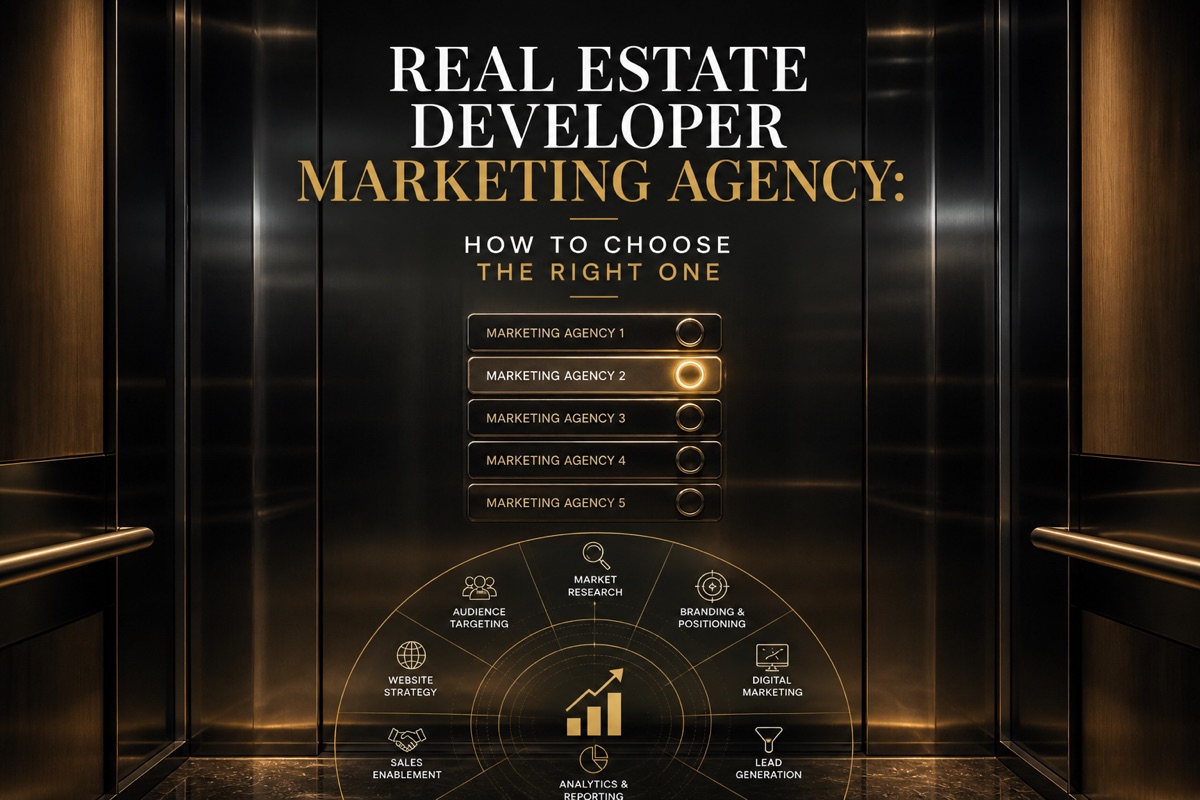
For more on what to look for (and what to avoid) in a marketing partner, see Real Estate Developer Marketing Agency: How to Choose the Right One.
FAQ: digital marketing for home builders
How long does it take for digital marketing to produce results for a home builder?
Paid advertising can generate leads within the first two to four weeks of a well-built campaign. Search engine optimization and content marketing typically take three to six months to produce meaningful organic traffic. Plan for a 90-day ramp period before evaluating the full system’s performance.
What should home builders spend on digital marketing?
Industry benchmarks suggest 1 to 3 percent of gross revenue for digital marketing. For a builder selling 50 homes per year at an average sale price of $400,000, that’s $200,000 to $600,000 annually. In practice, many regional builders underinvest significantly and then overspend on agents to compensate. A one-time infrastructure build at approximately $10,000, plus modest ongoing maintenance, typically competes very favorably against that math once the system is generating consistent direct leads.
Is Google Ads or Meta Ads better for home builders?
Both serve different roles. Google Ads captures buyers who are actively searching. They usually already know they want a new home. Meta Ads builds awareness and generates demand from buyers who aren’t searching yet but match your buyer profile. The most effective systems use both: Google for high-intent capture, Meta for top-of-funnel awareness and retargeting.
Do home builders need a CRM?
Yes. Without attribution, you cannot make intelligent decisions about marketing investment. A CRM built for home builders, with stages that match the actual buyer journey, automated nurture sequences, and lead scoring is not optional if you want to scale lead generation without scaling your sales team headcount.
What does a good home builder marketing system actually deliver?
At minimum: a website optimized for lead capture, paid advertising connected to measurable cost-per-lead, CRM configuration and automation, and reporting that connects marketing activity to sales pipeline. A complete system also builds organic infrastructure — SEO, content, AI search visibility, and email nurture — that compounds over time and reduces dependence on paid channels and agent networks.
Interested?
The clearest first move is a free AI Marketing Audit. Ten questions about your current marketing situation. The system analyzes your inputs and delivers a one-page custom report — where your biggest gaps are, which modules of the Real Estate Growth System address them, and what realistic results look like in 90 days. No sales call. No commitment. The report arrives in your inbox in under 30 minutes.